Ande Lloyd's Digital Portfolio
  • Home
  • Math 10
  • Advanced Algebra
  • Rockets

Math 10 Course Syllabus

Picture

Math 10 Mission Statement

The mission of this course is to help learners see the world through a rigorous mathematical lens by using the habits of a mathematician (generating ideas, recognizing/resolving errors, communicating, and synthesizing) to solve real world problems.

Course Overview

As a 10th-grade mathematician, you’re expected to work hard, advocate for yourself, and embrace mistakes as learning opportunities. Success in this class comes from being open to explaining your thinking and collaborating with others.

This class follows the Interactive Mathematics Program, which focuses on problem-based learning. Instead of just absorbing information, you'll explore math, develop analytical thinking, and build problem-solving skills. Expect to tackle challenging problems, and through the process, develop the skills needed to solve them.


​10th Grade Policies

Absences & Tardies:
You are responsible for checking Google Classroom for missed work and contacting your teachers for clarification. Full credit is possible for in-class assignments if made up; otherwise, without communication, you’ll receive a zero. Missing 20% of classes results in no credit for the course. Missing part of class, whether late arrival or early departure, affects your learning and the class. Unexcused tardies mean forfeiting points, and leaving early may cause you to miss critical information. Missing more than 15 minutes counts as an absence, and three tardies equal one unexcused absence per school policy.

Late & Missing Work:
After the due date, 10% will be deducted for the first week (five school days), after which you will be credited 25% for the assignment regardless of submission, ONLY for the “classwork” category.  Major summative assignments (quizzes, tests, POWs, projects, and exhibitions) will still need to be submitted to receive this 25% credit.

Extension Policy: 
We do understand that extenuating circumstances come up and can, at times, affect your ability to turn in assignments on time. We also value student advocacy as a skill to develop in the 10th grade. Therefore, we do generally allow deadline extensions in the case of extenuating circumstances. In order to receive an extension you MUST send a professionally written email to your teacher by 3:30 PM the day before an assignment is due. Any requests for extensions after that will NOT be accepted. Extensions on major assignments like tests, essays and projects are generally not given, but if something serious comes up and you communicate with us before the deadline, we will work with you to make a plan. (Fill out this form to request an extension)

Technology:
Bring a computer or equivalent every day. Technology is allowed only with explicit permission for academic purposes. Misuse results in confiscation: first infraction—confiscation for the class period, second—entire day with parental notification, third—technology is given to the Dean with further consequences. These strikes last for the semester. 

Your teachers are expected to uphold these norms as well.  Please help hold us accountable as members of this educational community!  We will put our phones in the phone tree, and email our parents if we are in violation of the policy.

Academic Integrity and AI:
AI tools like ChatGPT can be powerful, but they can also replace students’ own thinking and skill-building. AI may be used in limited, teacher-approved ways for specific tasks, but students may never use it to compose or revise their work. Doing so is plagiarism. Strikes apply across all classes and years at AHS and are outlined below:
  1. Strike 1: The student receives a 0 on the assignment. Students will be allowed to make up for partial credit through a process that will include a robust reflection and a re-do of the assignment on their own time. Parents/guardians are notified, and the academic dishonesty is reported to administration and the Dean of College and Career counseling.
  2. Strike 2: The student receives a 0 on the assignment that they cannot remediate. Parents/guardians are called in to meet with the student, teachers, and administration. The academic dishonesty is reported to administration and college and career.
  3. Strike 3: The student receives a 0 on the assignment that they cannot remediate. Parents/guardians are notified, and an official flag of academic dishonesty is added to their transcript. The academic dishonesty is reported to administration and college and career.
  4. Strike 4: The student receives a 0 on the assignment, parents/guardians and students are required to meet with the administration, and larger consequences may be assigned, up to and including suspension or expulsion.

Student Responsibilities with AI: To avoid being flagged for AI use, students must compose and revise their work in the same document, without copying and pasting from elsewhere. Because AI use can be difficult to prove, consequences may be applied based on reasonable suspicion and the teacher’s professional judgment. Students are responsible for showing their writing process through a clear and complete draft history. Any allowed AI use will be explained by individual teachers—when in doubt, ASK!

Assistive Technology and 504/IEP Accommodations: Students with 504 Plans or IEPs may use approved assistive AI tools to support their learning, as aligned with their specific plan. These tools can help with tasks like organizing ideas, summarizing information, checking grammar, reading text aloud, or generating practice questions. AI should be used to support understanding and independence, not replace original thinking or required work. If you are unsure how or when to use AI, check your accommodations plan and ask your teacher or case manager. When in doubt, ask!

Communication:
You are encouraged to take ownership of your assignments and grades. Before involving your parents, reach out to your teachers first with any questions. If concerns remain, we’ll discuss them with your parents. We encourage proactive communication about absences, challenges, and support needs, and ask that you first check Google Classroom, our DP’s, Infinite Campus, and the syllabus before contacting us. 
​

Grades

Weighted Grades: Grades are weighted based on five different categories. 
  1. Classwork (30%): On average there will be 2-3 assignments per week that are worth 10 points each.

  2. Starters (10%): Almost everyday there will be a starter worth 2 points and it is based on completion. Oftentimes these are short quizzes to help gage understanding. 

  3. POWs (10%): POWs are open ended problems that require multiple steps and problem solving skills to complete. These are valuable assignments that teach you skills relevant to any subject. The process of completing the POW is valued more than the answer and these assignments usually require a short write up or presentation. There will be some class time allotted for POWS but they are homework. 

  4. Projects (30%): There will be 1-2 projects per semester. See projects at a glance below for more information.

  5. Test and Quizzes (20%): There are about one test per unit over the course of the year, with four tests total. 

Projects at a Glance

Rocket Project (Semester 1)

Essential Question: How do rockets fly?

Enduring Understandings:
  • The engineering design process is a cycle of testing and failing until a design works. 
  • The acceleration due to gravity has a velocity that is constantly changing, and can be graphed with a quadratic function.
  • Acceleration, Velocity, and position are all related to each other’s slopes on a graph.

Topics Covered:
  • Projectile Motion
  • Velocity and Acceleration
  • Quadratic Functions 
  • Factoring
  • Completing the Square
  • Quadratic Formula
Picture

Cookies Unit (Semester 1)

Unit Question: How do you optimize profit for selling cookies with a fixed number of materials and time?

Enduring Understandings:
  • Every possible combination of products must be inside the feasible region. 
  • The best solutions will be on the edge of the feasible region. 
  • Producing and selling a high volume of products is critical for maximizing profit.

Topics Covered:
  • Inequalities
  • Systems of linear equations
  • Substitution 
  • Systems of linear inequalities
  • Feasible regions 
  • Modeling linear equations and inequalities
Picture

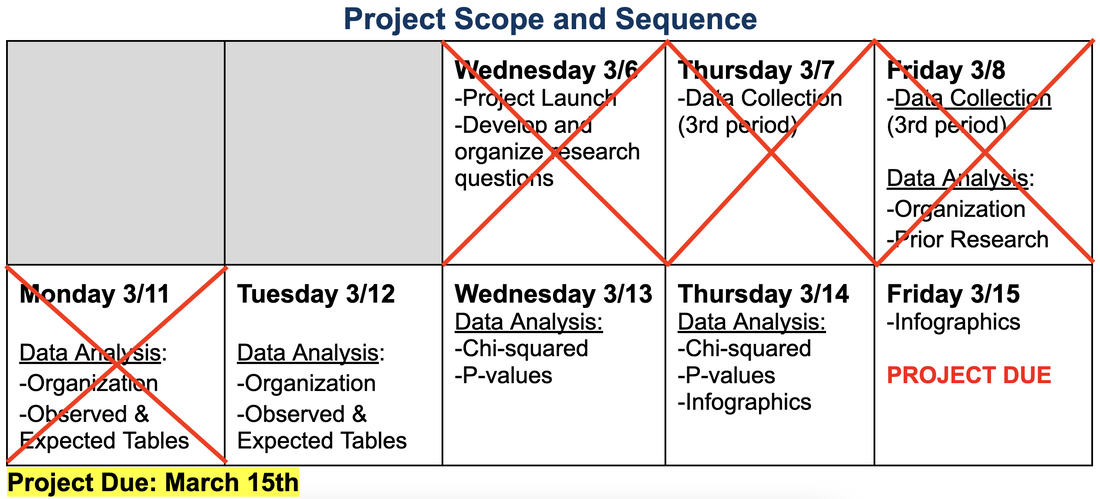
Statistics in Minecraft (Semester 2)

Essential Question: How lucky is too lucky? How can we use probability and statistics to make conclusions about the world around us?

Enduring Understandings:
  • Sampling bias and experimental design flaws can distort results, leading to incorrect or misleading conclusions. Recognizing and minimizing bias is key to accurate data analysis.
  • The quality and reliability of statistical conclusions depend on how well the sample reflects the larger population.
  • Probability provides a way to measure and understand uncertainty, helping us make sense of seemingly random events and assess their likelihood.

Topics Covered:
  • Sampling Methods
  • Normal Distribution
  • Sampling Bias
  • Standard Deviation
  • Experimental Design
  • Collecting and Analyzing Data
  • Modeling with Frequency Graphs
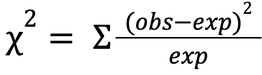
  • Interpreting p-values
  • Hypothesis Testing
  • Identifying populations and samples
Picture

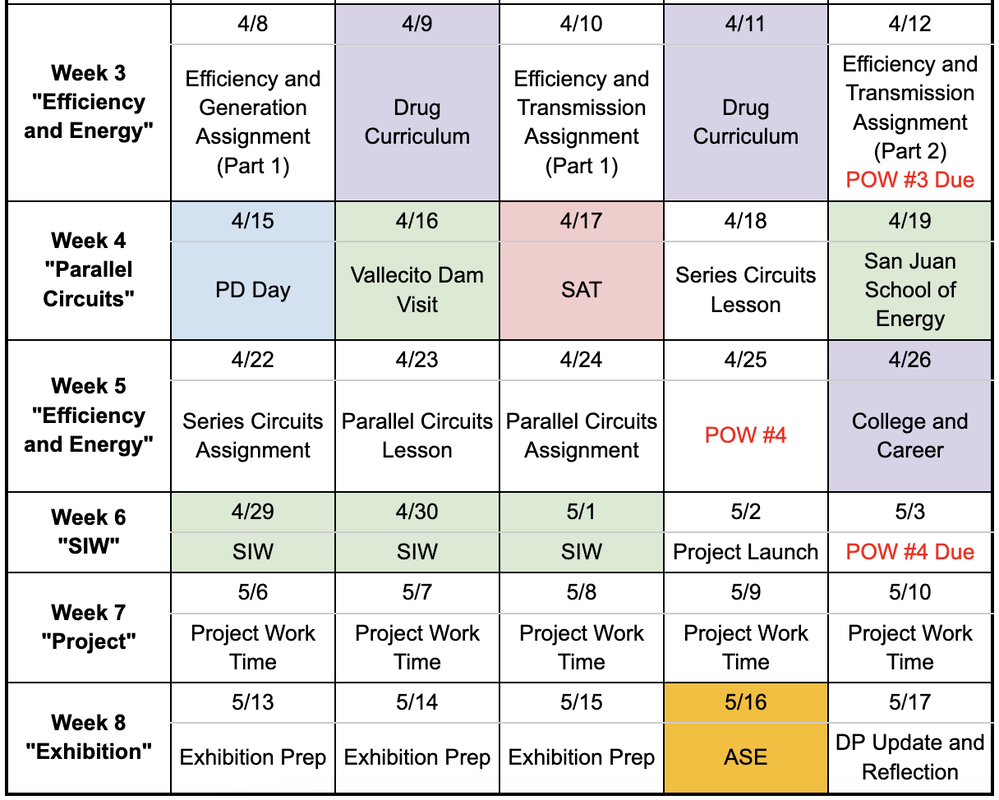
Energy Project (Semester 2)

Essential Question: How might we build a just and sustainable energy future?

Enduring Understandings:
  • Efficiency can be thought of as not wasting anything
  • Heat/sound is energy loss in a system
  • Transferring one form of energy to another loses energy in the process.

Topics Covered:
  • Ohm’s Law
  • Voltage, Current, Resistance, Power
  • Energy Transfers (Light, Motion, Heat)
  • Generation, Transmission, Consumption

Class Supply List

You should have all your class materials by the end of the second week of school, August 26th. 

​
1) Notebook Paper
Picture
Picture
2) 3-Ring Binder

Picture
3) At least 1 Pocket Style Folder

4) Whiteboard markers
Picture
Super Secret: If you bring a 2-Liter soda bottle that is empty and clean, I will pay you in candy. 1 bottle = 1 piece of candy

Powered by Create your own unique website with customizable templates.